
From Google Dominance to AI Search: How Digital Visibility Is Changing
AI is changing how people find information. Explore how Google, AI-generated answers and new search behaviours are reshaping digital visibility—and why businesses need to measure more than rankings.

From Google Dominance to AI Search: How Digital Visibility Is Changing
For many years, digital visibility was relatively straightforward to understand. A potential customer searched for a product or service on Google, received a list of results and clicked through to a website. For businesses, much of the work focused on appearing near the top of that list.
Success was not necessarily easy to achieve, but the objective was clear: become visible in search results, attract clicks and convert that traffic into customers.
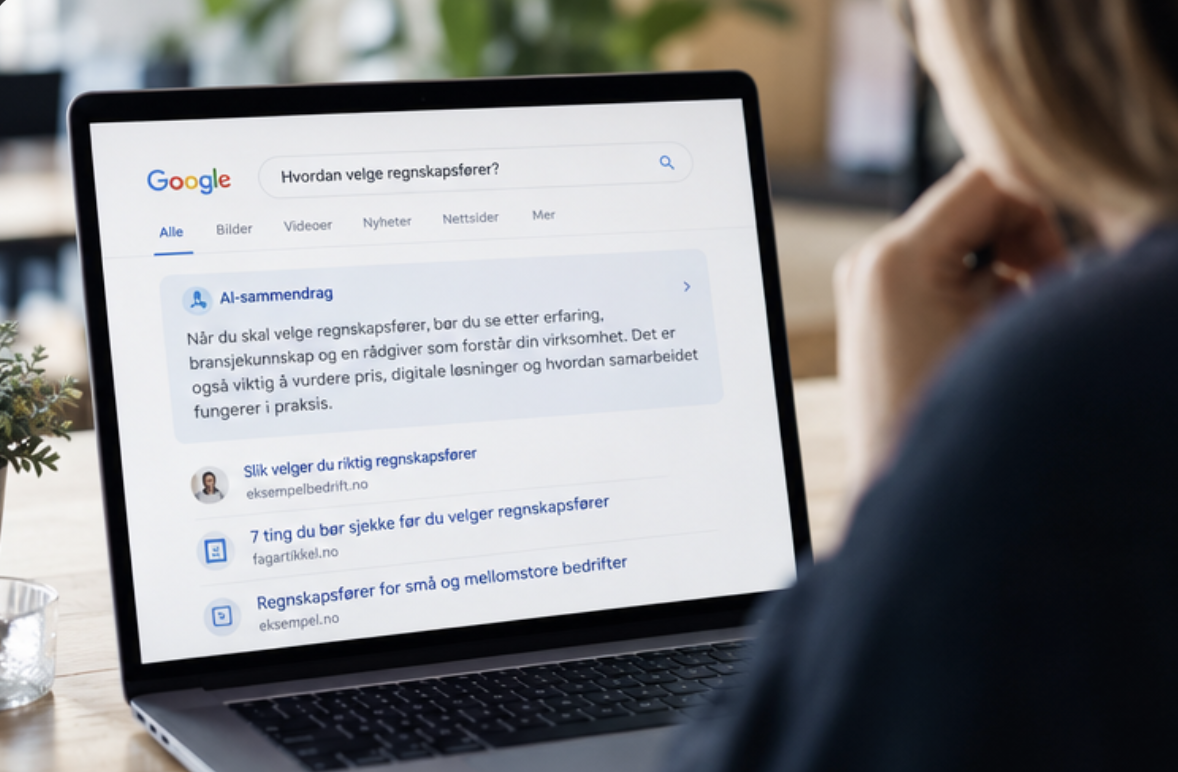
Today, the picture is more complex. People still use Google, but search results increasingly contain AI-generated summaries. At the same time, services such as ChatGPT and Perplexity have made it possible to investigate questions through conversations and receive synthesised answers instead of a traditional list of links.
This does not mean Google has lost its importance. It means the way people find information is changing. For businesses working with SEO and digital marketing, this has implications for both strategy and measurement.
Google Was the Gateway to the Internet
When search engines became a central part of the internet, they changed how people found information. Google eventually became the dominant player by making it easier to find relevant websites among ever-growing volumes of information.
For businesses, this created a clear competitive arena. Those that managed to rank highly for relevant keywords could attract traffic from people who were already interested in what they offered.
SEO developed around this mechanism. Technical accessibility, relevant content, links from other websites and a good user experience became important elements of achieving visibility.
Google remains highly dominant. According to statistics from Statcounter, Google accounted for approximately 90% of the global search engine market in 2025. Market share varies by period, device and geographical region, but the figures demonstrate that traditional search engines continue to play a central role.
It is therefore incorrect to conclude that SEO is on its way out. What is changing is what a search experience can consist of, and which forms of visibility businesses need to consider.

How Many Searches Are Actually Being Made?
The scale of search activity shows why these changes matter.
In May 2025, Google reported that its service handled more than five trillion searches annually, equivalent to an average of over 13.7 billion searches per day. This is Google’s own reported figure for activity on its platform, not a combined count of all searches across the internet.
The figure gives an indication of the scale of the search market. But it does not tell the whole story of how people find information.
First, searches take place across many platforms. Second, the purpose of a search varies. Some people want a simple fact, others investigate a problem in depth, and some compare providers before purchasing a service.
Third, a search today can lead to an answer without the user visiting an external website. This is an important difference from the traditional model, in which a search engine primarily served as a gateway to other websites.
That is why counting searches is not enough. We also need to understand what happens after the question has been asked.
AI Is Moving into the Search Experience
One of the most important changes is that artificial intelligence is not merely competing with traditional search engines. AI is also being integrated into them.
Google’s AI Overviews are a clear example. The feature presents AI-generated summaries directly in search results, with links to sources that users can explore further. Google has also introduced AI Mode, which supports more exploratory searches and follow-up questions.
In July 2025, Google reported that AI Overviews had more than two billion monthly users across over 200 countries and territories. This is a global user figure reported by Google itself, not a measure of how many individual searches are conducted using the feature.
The development illustrates an important point: AI search is not limited to people who open a separate chatbot. Artificial intelligence can be part of the search itself, even when the user remains on Google.
This makes the distinction between traditional search and AI search less clear-cut. Someone might begin with an ordinary search, read an AI-generated summary, open a source, ask another question and continue the investigation through a conversational feature.
For businesses, this means that the customer journey can involve several types of search experiences, even within the same platform.

From Ranking to Being Selected as a Source
Traditional SEO has often focused on where a website ranks for a particular keyword. A position on the first page can generate significant visibility, while a lower position generally attracts fewer visits.
AI-generated answers introduce a different question. A system can present a consolidated explanation and refer to selected sources. A business can therefore contribute to an answer without necessarily receiving a click from the user.
It is useful to distinguish between three forms of visibility:
Ranking: How highly the website appears in traditional search results.
Mention: Whether the business is mentioned in an AI-generated answer when someone investigates a relevant topic.
Source citation: Whether the AI service refers to the business’s website as a source for the information it presents.
These factors are related, but they are not identical. A business can rank well on Google without being mentioned in a particular AI answer. It can also be mentioned in an answer without that mention generating a visit to its website.
It is therefore too simplistic to treat AI visibility as merely a new version of traditional rankings. It is also about how a business’s expertise and content are used when digital systems synthesise information.
When the Answer Replaces the Click
One of the most interesting consequences of AI in search results is that users do not always need to visit a website to get an answer to their question.
A study by Pew Research Center, published in July 2025, examined how US users behaved when Google displayed AI-generated summaries. The study was based on browser data from 900 adults and analysed, among other things, 68,879 unique Google searches.
The results showed that users clicked on a traditional link in 8% of searches where an AI summary appeared. When no such summary was displayed, the proportion was 15%. Clicks on links within the AI summary itself occurred in only 1% of visits where a summary was present.
These figures are not universal click-through rates for all searches or markets. The study concerns US users and a specific observation period. Nevertheless, it illustrates a relevant challenge: a business can be visible in search results without that visibility generating the same level of traffic as before.
This can affect how SEO results are evaluated. If traffic declines, it does not necessarily mean that the content has lost all visibility or relevance. Part of the explanation may be that users receive more information directly in the search results.
At the same time, it is important to avoid concluding that AI summaries always reduce traffic. The effect will depend on search intent, content type, user needs and how the results are presented.

Customers Search in More Places—and in Different Ways
Google remains a central channel, but businesses should not assume that every relevant investigation takes place through traditional search.
A customer might use Google to find potential providers, ChatGPT to understand the differences between two solutions, and Perplexity to investigate a question with source citations. Others may discover a business through specialist articles, discussions, social media or recommendations from other people.
The key is not to be present everywhere at any cost. It is to understand which channels and search experiences are relevant to the customers a business actually wants to reach.
For a consultancy, for example, it may be important to be discovered when a manager investigates a specific issue in business management or compliance. For a digital services provider, being considered when a customer compares different solutions may be crucial.
This requires content that goes beyond general definitions. A business should also explain practical problems, differences between alternatives, common pitfalls and the factors that should be considered before making a decision.
Such content can help both people and digital systems understand what the business can actually contribute. It does not guarantee that an AI service will mention the business, but it provides a stronger basis for being discovered and evaluated.
Why Measuring Digital Visibility Is Becoming More Complex
Previously, a business could assess its performance largely through rankings, organic traffic, clicks and conversions. These metrics remain important, but they do not describe every way a business can become visible.
In AI-based search experiences, it is necessary to distinguish between whether a business is discovered, whether it is mentioned, whether its website is used as a source, and whether any of this leads to a visit or an enquiry.
There is also no single, universal AI ranking that shows how visible a business is across all services. Results can vary between platforms, wording, languages and points in time. A single test search therefore does not provide a complete picture of a business’s visibility.
Traffic measurement has its own limitations. Visits from some AI services can be identified in analytics tools, but a mention that does not generate a click will normally not appear as a website visit. Referral traffic can therefore reveal some of the impact, but not the whole picture.
It is also important to distinguish between AI features within Google and traffic from separate AI services. A visit originating from a chatbot may be recorded as a referral from that service. Someone who reads an AI summary in Google and then clicks on a conventional search result, however, will often be recorded as organic search traffic.
An analysis of traffic alone therefore cannot always explain the role AI played in a customer’s decision-making process.

How Businesses Should Track the Development
The first step is not to abandon existing SEO reporting. It is to expand it.
Continue measuring organic traffic, rankings, indexing, conversions and which pages generate relevant enquiries. These metrics still provide valuable information about how the website is performing.
Then supplement this with a structured examination of AI visibility. Select questions that potential customers might realistically ask about the business’s field, services and solutions. Test these questions in relevant AI services and record which businesses and sources are mentioned.
Repeat the investigation at regular intervals. Use the same questions wherever possible so that results are easier to compare. At the same time, recognise that AI responses are not entirely stable and that manual tests do not provide a scientifically representative measure of overall visibility.
Also investigate whether the website receives visits from AI services and whether those visits lead to desired actions. If you discover that the business is frequently mentioned in one subject area but rarely in another, this may provide ideas for future content development.
The objective is to understand both visibility and its commercial significance. The number of mentions is interesting, but its value becomes clearer when considered alongside relevant visits, enquiries and sales.
SEO Is Not Gone—but Reporting Must Evolve
It is easy to describe this development as a battle between Google and AI. In practice, the picture is more complex. Google is integrating AI into its own search services, while independent AI services offer new ways to find and evaluate information.
Traditional SEO remains an important part of this landscape. Websites need to be technically accessible, content must be relevant, and a business’s professional position should be reflected in what it publishes and in how others describe it.
The difference is that rankings no longer tell the whole story. Businesses must also investigate whether they are mentioned in relevant AI answers, whether their content is used as a source, and whether that visibility contributes to their business objectives.
This does not require measuring everything at once. It requires selecting a few relevant questions, tracking developments systematically and using the results to prioritise action.
Digital visibility is no longer just about where a business ranks. It is also about where it is discovered, how it is presented, and whether that visibility makes it easier for potential customers to find the right expertise.
Continue Reading
More practical thinking on trust, discovery, and building a digital presence that compounds over time.




See where your biggest opportunities are
Start with a complimentary SEO audit and discover where your greatest opportunities for sustainable growth are hiding